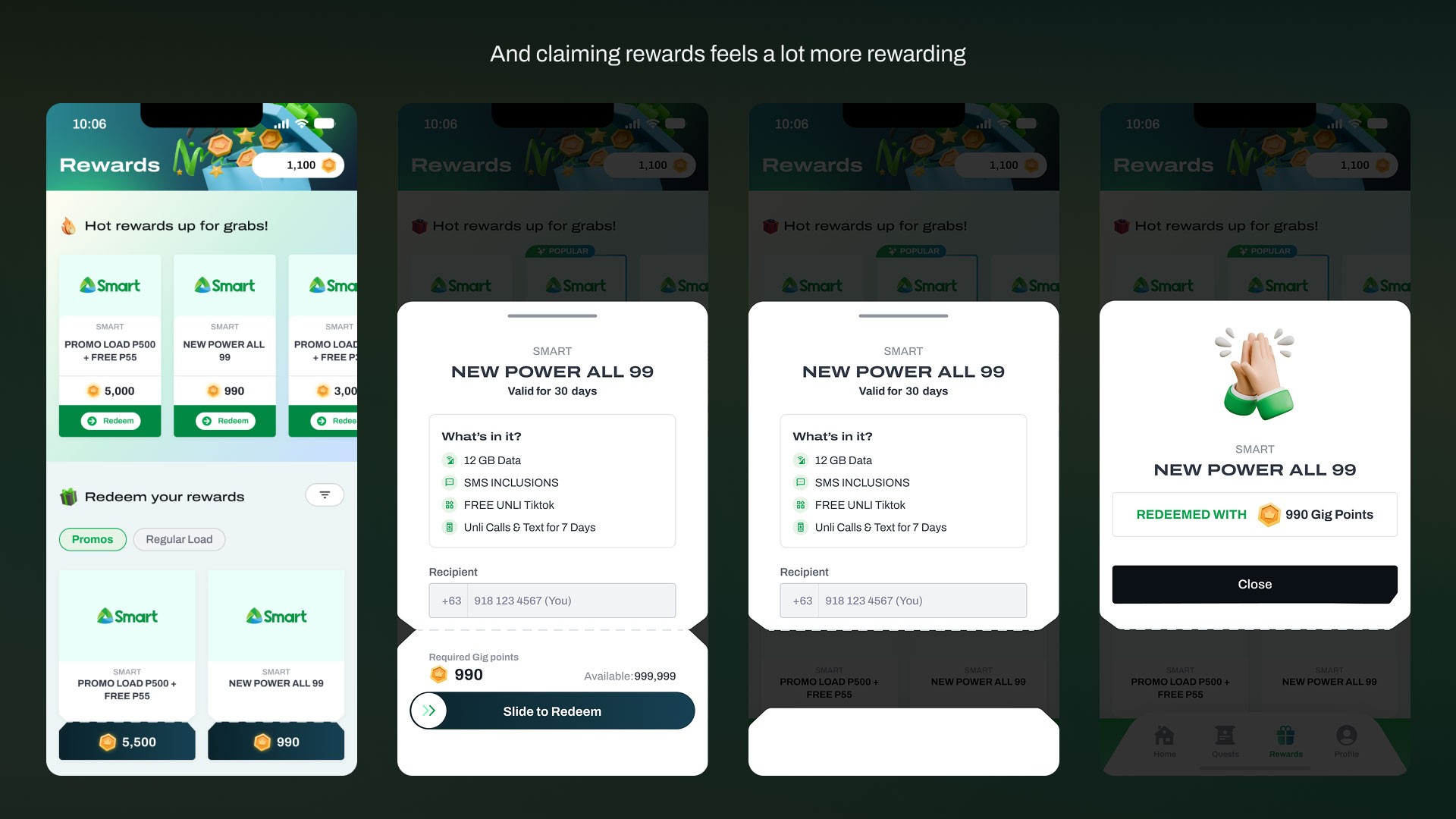
GIG Rewards is a rewards platform born from a collaboration between three companies: ED3N Ventures, YGG, and Sovrun. It enables users to complete simple quests, earn points, and redeem free Smart and TNT load and data. By leveraging telco networks, GIG taps into millions of existing mobile users who would never seek out a Web3 product on their own.

YEAR
2024
ROLE
Head of Design /
Product Design Lead
RESPONSIBILITIES
Identity Design,
Visual Design,
End-to-end UI & UX Design
About the work
Challenge
Web3 has an onboarding problem. For most people, crypto and blockchain are immediately associated with investing, trading, or scams. That perception creates a wall: new users assume they need technical knowledge or digital currency just to participate. The challenge was to design a product that introduces Web3 brands to a mainstream Filipino audience without ever making it feel like a Web3 product. No wallets, no jargon, no friction. Just quests, points, and free load.
Approach
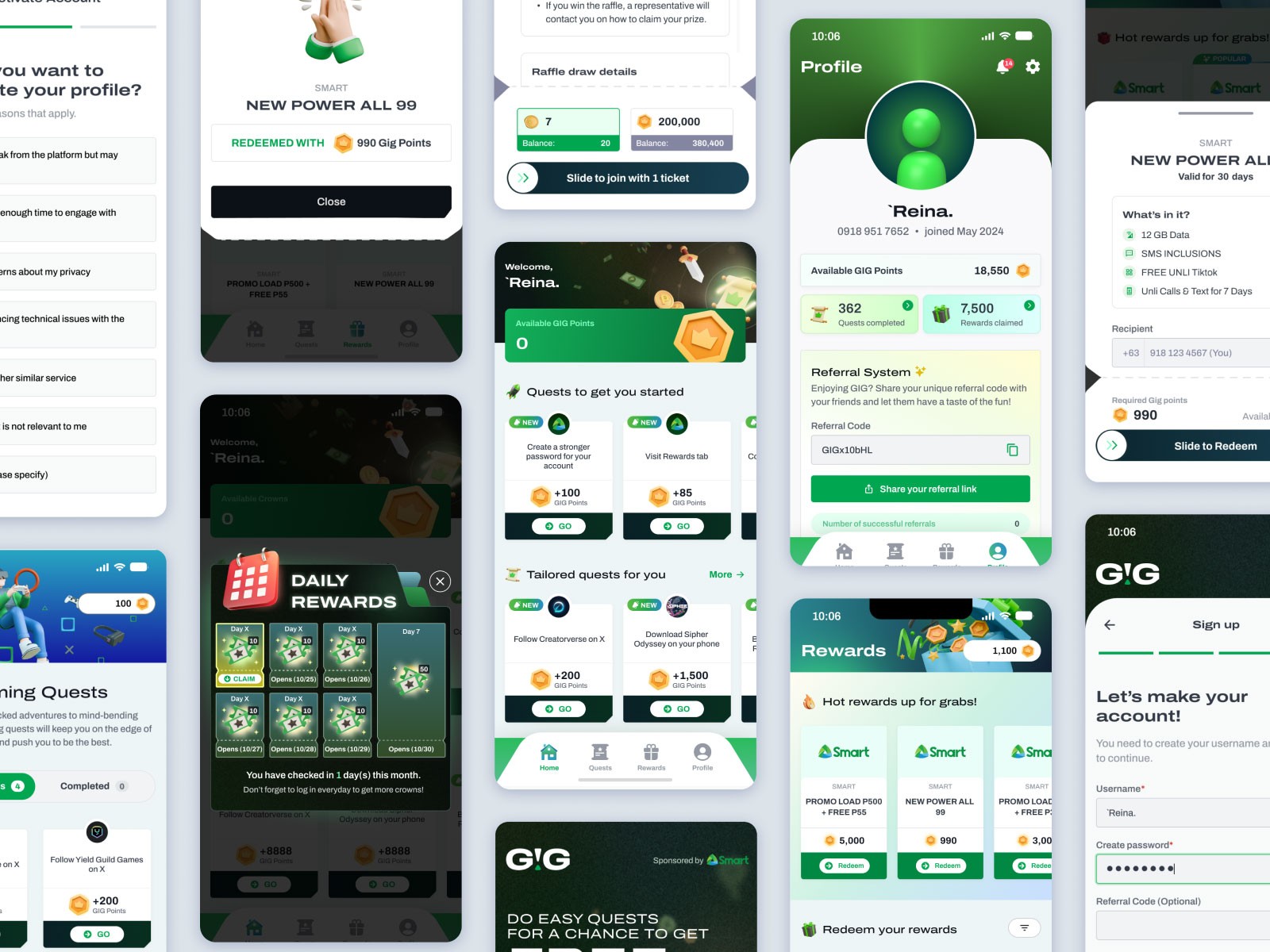
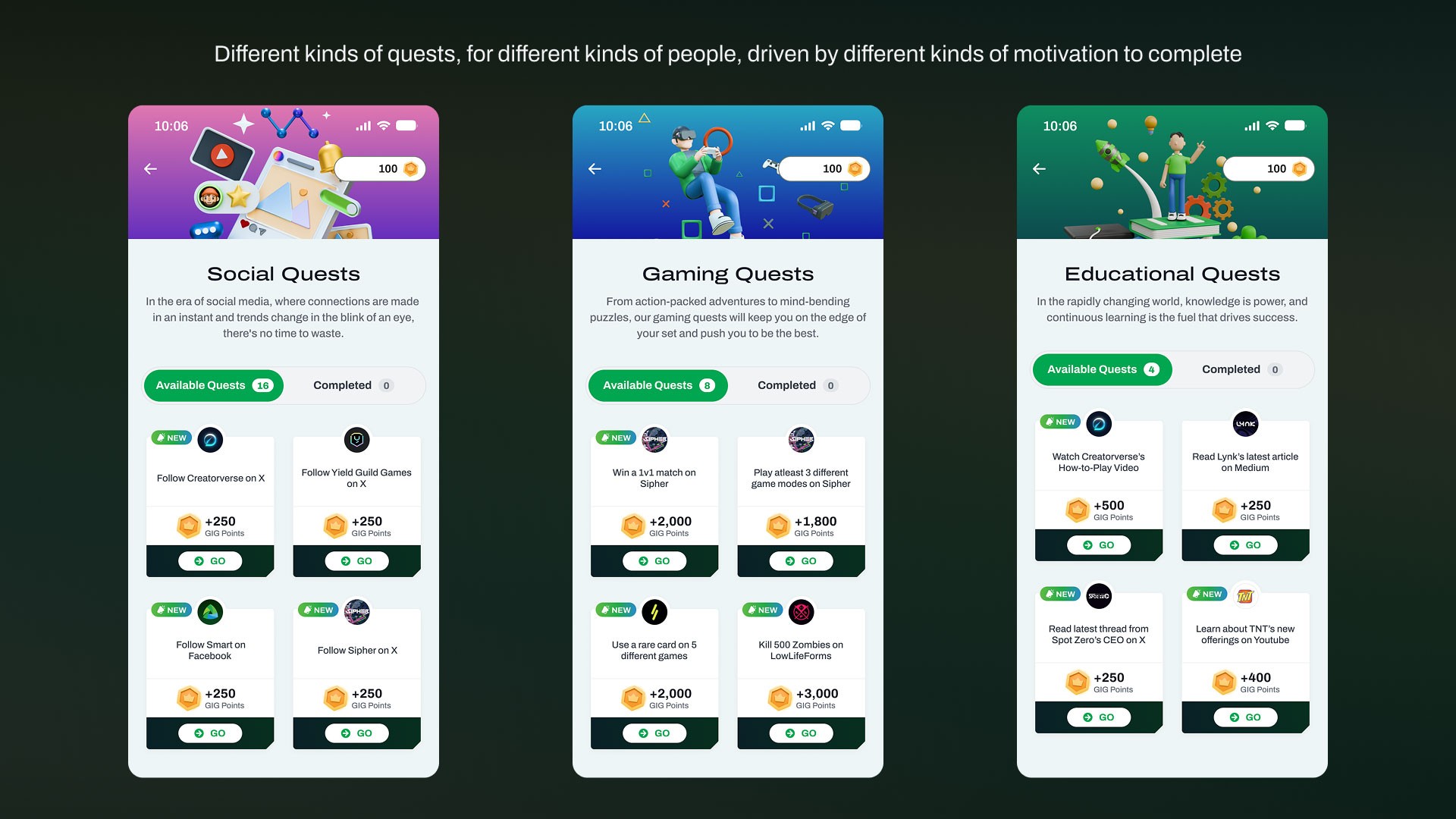
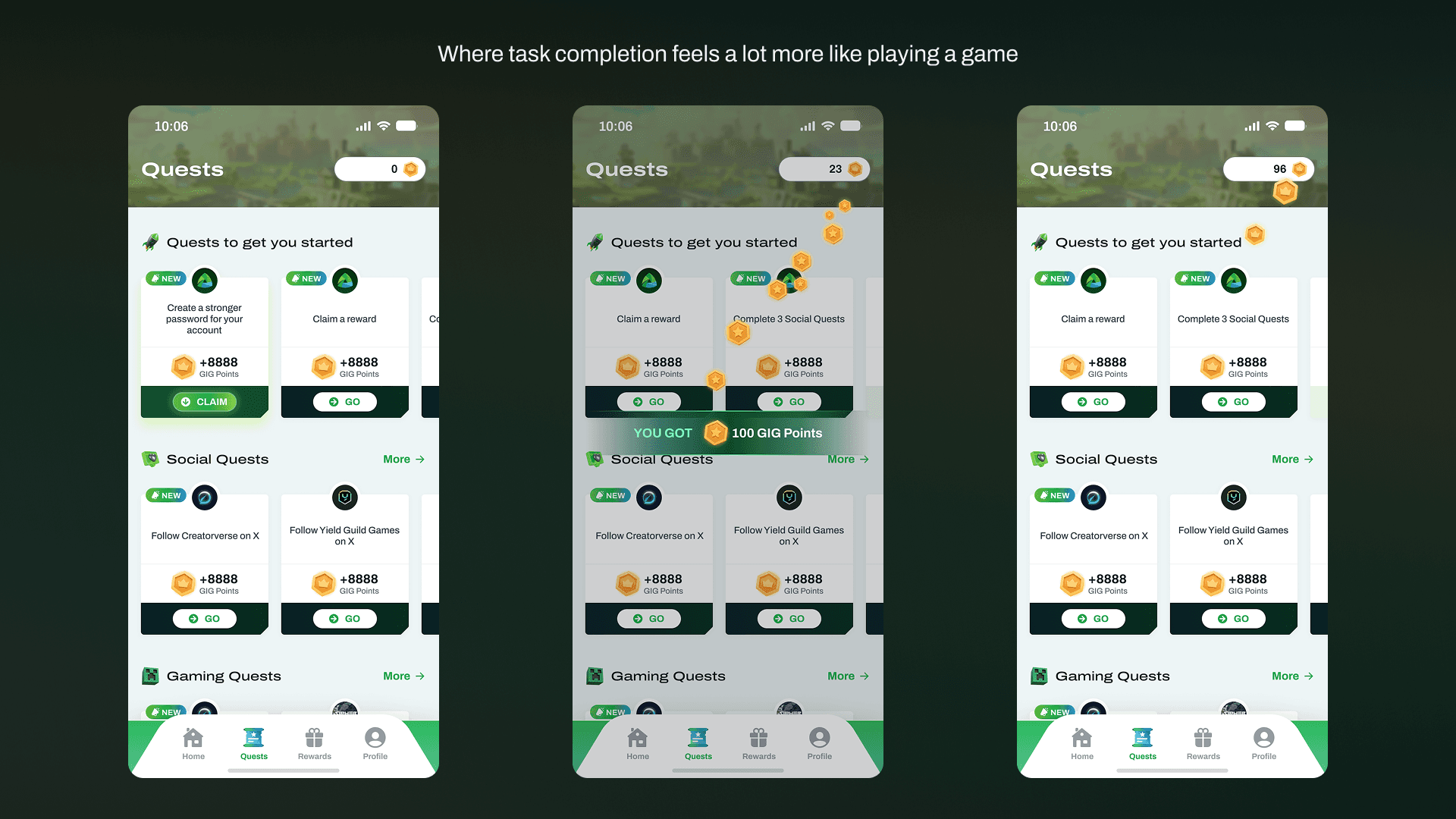
I owned the end-to-end product design, from user research through visual design, interaction design, prototyping, and branding. The core design principle was invisibility: Web3 infrastructure powers the platform, but the user never needs to know that. Every interface decision was made to feel familiar to someone who has only ever used GCash or a telco rewards app. The quest flow was designed to be completable in seconds, not minutes. The visual language was built to feel bright, approachable, and unmistakably Filipino, not like a crypto product wearing consumer clothing. I worked with Carlos Perez on 3D icons and Yayay De Castro on completing core user flows.
Outcome
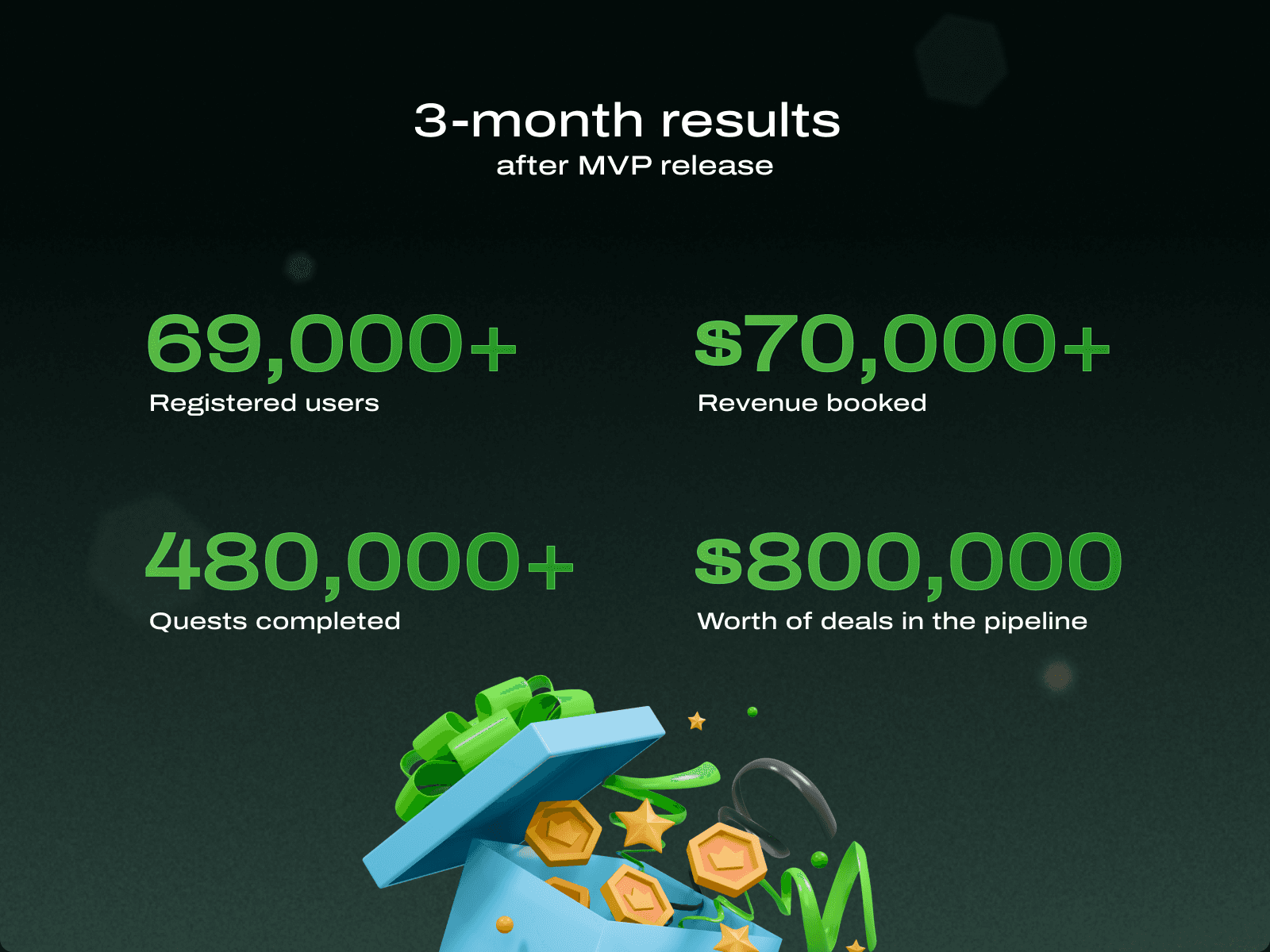
G!G Rewards shipped as a functional product bridging Web3 brands with mainstream telco users in the Philippines. The platform successfully abstracts blockchain complexity behind a familiar rewards experience, making Web3 engagement feel as natural as redeeming prepaid load.
It stands as a proof point that Web3 adoption doesn't require user education. It requires better product design.
Smooth Scroll
This will hide itself!
This will hide itself!
GIG Rewards
ABOUT THE PROJECT
GIG Rewards is a rewards platform born from a collaboration between three companies: ED3N Ventures, YGG, and Sovrun. It enables users to complete simple quests, earn points, and redeem free Smart and TNT load and data. By leveraging telco networks, GIG taps into millions of existing mobile users who would never seek out a Web3 product on their own.
YEAR
2024
ROLE
Head of Design /
Product Design Lead
RESPONSIBILITIES
Identity Design,
Visual Design,
End-to-end UI & UX Design
About the work
Challenge
Web3 has an onboarding problem. For most people, crypto and blockchain are immediately associated with investing, trading, or scams. That perception creates a wall: new users assume they need technical knowledge or digital currency just to participate. The challenge was to design a product that introduces Web3 brands to a mainstream Filipino audience without ever making it feel like a Web3 product. No wallets, no jargon, no friction. Just quests, points, and free load.
Approach
I owned the end-to-end product design, from user research through visual design, interaction design, prototyping, and branding. The core design principle was invisibility: Web3 infrastructure powers the platform, but the user never needs to know that. Every interface decision was made to feel familiar to someone who has only ever used GCash or a telco rewards app. The quest flow was designed to be completable in seconds, not minutes. The visual language was built to feel bright, approachable, and unmistakably Filipino, not like a crypto product wearing consumer clothing. I worked with Carlos Perez on 3D icons and Yayay De Castro on completing core user flows.
Outcome
G!G Rewards shipped as a functional product bridging Web3 brands with mainstream telco users in the Philippines. The platform successfully abstracts blockchain complexity behind a familiar rewards experience, making Web3 engagement feel as natural as redeeming prepaid load.
It stands as a proof point that Web3 adoption doesn't require user education. It requires better product design.
Smooth Scroll
This will hide itself!
This will hide itself!
GIG Rewards
ABOUT THE PROJECT
GIG Rewards is a rewards platform born from a collaboration between three companies: ED3N Ventures, YGG, and Sovrun. It enables users to complete simple quests, earn points, and redeem free Smart and TNT load and data. By leveraging telco networks, GIG taps into millions of existing mobile users who would never seek out a Web3 product on their own.
YEAR
2024
ROLE
Head of Design /
Product Design Lead
RESPONSIBILITIES
Identity Design,
Visual Design,
End-to-end UI & UX Design
About the work
Challenge
Web3 has an onboarding problem. For most people, crypto and blockchain are immediately associated with investing, trading, or scams. That perception creates a wall: new users assume they need technical knowledge or digital currency just to participate. The challenge was to design a product that introduces Web3 brands to a mainstream Filipino audience without ever making it feel like a Web3 product. No wallets, no jargon, no friction. Just quests, points, and free load.
Approach
I owned the end-to-end product design, from user research through visual design, interaction design, prototyping, and branding. The core design principle was invisibility: Web3 infrastructure powers the platform, but the user never needs to know that. Every interface decision was made to feel familiar to someone who has only ever used GCash or a telco rewards app. The quest flow was designed to be completable in seconds, not minutes. The visual language was built to feel bright, approachable, and unmistakably Filipino, not like a crypto product wearing consumer clothing. I worked with Carlos Perez on 3D icons and Yayay De Castro on completing core user flows.
Outcome
G!G Rewards shipped as a functional product bridging Web3 brands with mainstream telco users in the Philippines. The platform successfully abstracts blockchain complexity behind a familiar rewards experience, making Web3 engagement feel as natural as redeeming prepaid load.
It stands as a proof point that Web3 adoption doesn't require user education. It requires better product design.
Smooth Scroll
This will hide itself!
This will hide itself!